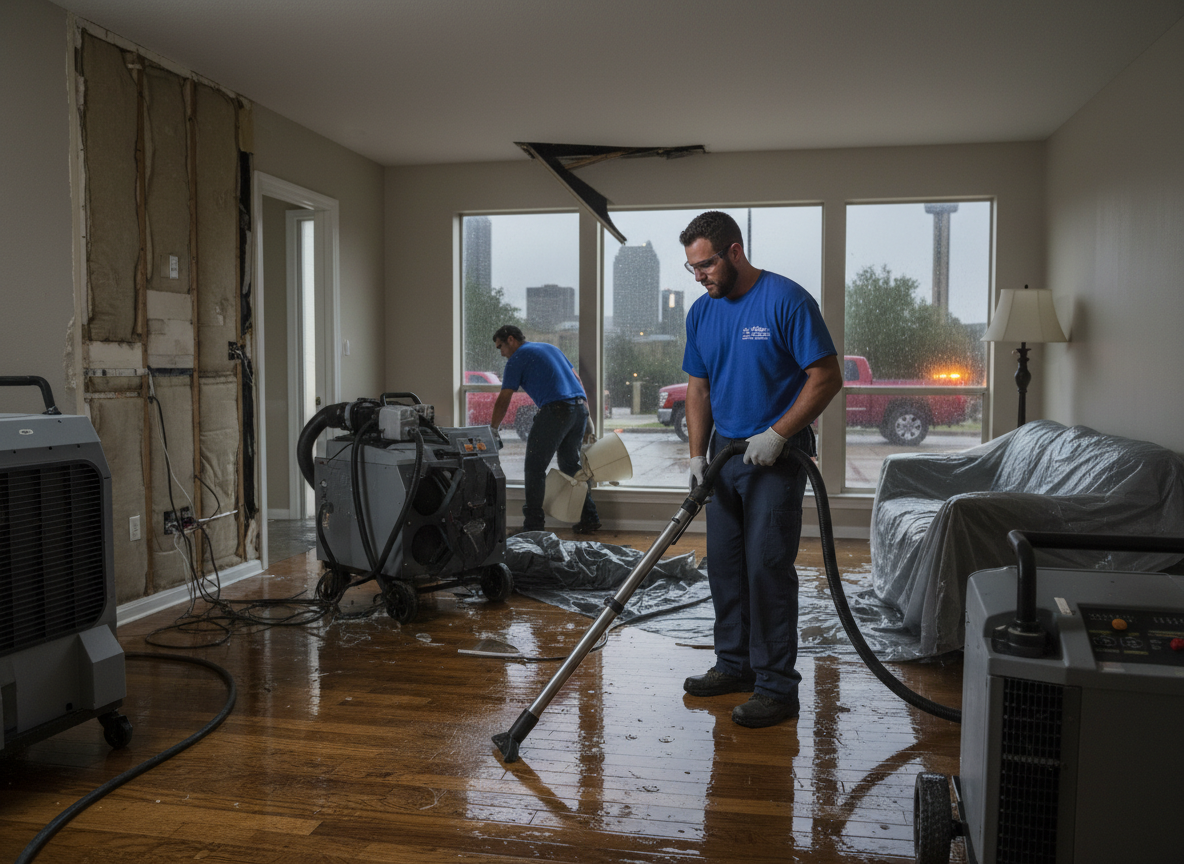
San Antonio summers push humidity high enough that standing water in a King William or Southtown crawlspace can trigger mold within forty-eight hours on the original plaster and lathe walls common in homes built before 1940. Mild winters keep soil moisture elevated year-round, so a slow leak under a Downtown slab often travels farther than homeowners expect before it surfaces near The Alamo or River Walk properties. Technicians must pull baseboards early and use moisture meters on brick piers that sit directly on Bexar County clay, because trapped moisture behind those piers will ruin hardwood floors months later.
River Walk and Southtown properties sit on older terra-cotta drain lines that crack when tree roots from the nearby San Antonio Zoo greenbelt push through during heavy spring rains. Once water backs up, it saturates the limestone foundations typical of Alamo Heights homes, requiring targeted drying behind built-in cabinetry rather than whole-room fans. Crews also watch for hidden cast-iron supply lines in 1920s bungalows that split at the joints when hot attic temperatures expand the metal after a cold front passes.
Downtown high-rises and King William row houses share party walls, so water from a unit above can travel laterally through shared brick and appear in a neighbor’s ceiling days later. Restoration plans therefore include documenting moisture migration paths with infrared cameras before any demolition begins, and crews coordinate with Bexar County permitting when structural joists need temporary shoring near historic districts.
Technician insight
In San Antonio, the thing that catches most people out with 24/7 Water Damage Restoration is the way Bexar County clay holds water against 1920s pier-and-beam foundations in King William and Alamo Heights; homeowners often stop at surface drying and miss the moisture that later buckles original hardwood floors.
Southtown Row House After Heavy Rain
Water entered through a cracked terra-cotta line and pooled under the dining room floor of a 1930s Southtown home. Infrared showed saturation had traveled into the shared wall with the neighboring unit. Extraction and targeted drying behind the baseboards prevented mold and kept the original oak intact.
24/7 Water Damage Restoration Services We Offer
✓Emergency Water Extraction
Rapid removal of standing water from basements and crawlspaces in older San Antonio homes using truck-mounted pumps sized for Bexar County clay soil conditions.
✓Structural Drying After Storms
Targeted drying of plaster walls and hardwood floors in King William and Alamo Heights properties using commercial dehumidifiers calibrated for local summer humidity spikes.
✓Slab Leak Containment
Isolation and drying of water under concrete slabs common in Southtown and Downtown buildings before moisture migrates to adjacent units.
✓Historic Home Moisture Mapping
Infrared and probe readings on pre-1940 homes near the River Walk to locate hidden saturation behind limestone and brick without unnecessary demolition.
✓Crawlspace Water Removal
Extraction and vapor barrier drying in elevated King William and Alamo Heights foundations where mild winters keep soil moisture high year-round.
24/7 Water Damage Restoration Cost in San Antonio, TX
| Service | Typical Range | What Affects It |
|---|---|---|
| Initial Assessment and Moisture Mapping | $150–$350 | Larger historic homes in King William require more probe points. |
| Emergency Water Extraction | $400–$900 | Depends on depth and whether slab or crawlspace access is needed. |
| Structural Drying (per day) | $250–$600 | Higher in summer humidity; multiple dehumidifiers often required. |
| Final Verification and Report | $100–$200 | Includes infrared scan for shared-wall properties. |
Ranges are typical for San Antonio, TX and confirmed with an exact written quote before any work starts.
How it works
- 1
On-Site Assessment
Technician arrives within hours, documents moisture levels in walls, floors and piers, and notes any shared-wall migration risks typical of Downtown and Southtown buildings.
- 2
Water Extraction
Truck-mounted equipment removes standing water while protecting original hardwood and plaster finishes found in Alamo Heights and King William homes.
- 3
Drying and Monitoring
Industrial dehumidifiers and air movers run until moisture readings return to normal, with daily checks to prevent mold in the humid Bexar County climate.
- 4
Final Verification
Infrared scan and written report confirm all affected materials are dry before any reconstruction begins.
Pricing
Upfront quotes after inspection; price varies by water volume, affected materials and access in older Bexar County homes.