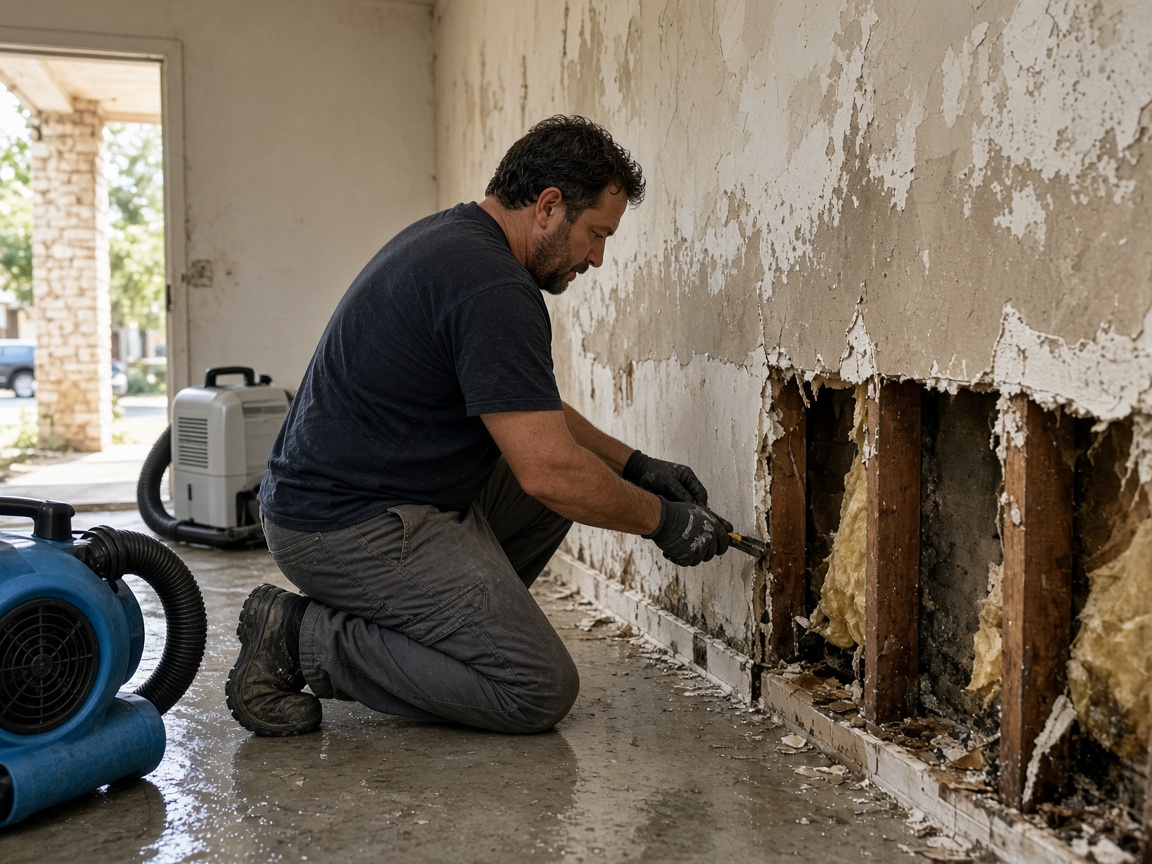
Older homes in King William and Alamo Heights often feature plaster walls over lath and raised foundations that trap moisture after a pipe burst or roof leak. When water migrates behind these materials it can travel along joists for days before visible signs appear on the first floor. Technicians must open walls at multiple points and use moisture meters to map the full extent rather than relying on surface readings alone.
Bexar County summers bring high humidity and frequent afternoon thunderstorms that overload gutters and low-lying yards in Southtown and near the River Walk. Mild winters keep soil saturated longer, increasing hydrostatic pressure against basement walls in Downtown properties. These conditions require dehumidifiers sized for 80-plus percent relative humidity and air movers directed into wall cavities to prevent secondary mold growth within 48 hours.
San Antonio building practices from the 1920s through 1960s left many homes with cast-iron drains that corrode from the inside. When a cleanout plug fails or a sewer line backs up, contaminated water reaches living spaces quickly. Restoration crews separate Category 3 water jobs from clean-water events immediately and use antimicrobial rinses on subfloors before any drying equipment is placed.
After extraction, the drying phase in local masonry and stucco homes demands attention to the thermal mass of thick exterior walls that release moisture slowly. Technicians monitor daily moisture readings on both sides of every affected wall and adjust equipment placement rather than running a fixed schedule. Final clearance includes checking hidden areas such as under kitchen cabinets and behind tile in bathrooms common in Bexar County construction.
Technician insight
In San Antonio the thing that catches most people out with water damage repair is how quickly moisture travels behind the plaster in 1920s–1950s homes in King William and Alamo Heights; mild winters keep the ground damp so a small leak can saturate subfloors for weeks before anyone notices.
Southtown Kitchen Leak
A supply line under a sink in a 1940s Southtown bungalow released water overnight. Inspection found saturation extending into the adjacent dining room subfloor and up two wall cavities. Technicians extracted water, removed base cabinets and drywall sections, then ran drying equipment for four days until readings matched unaffected areas. New drywall and cabinets were installed with no visible signs of prior damage.
Water Damage Repair Services We Offer
✓Emergency Water Extraction
Rapid removal of standing water from floors and carpets using truck-mounted pumps to limit migration into subfloors common in older Bexar County homes.
✓Structural Drying and Dehumidification
Placement of commercial air movers and dehumidifiers sized for San Antonio humidity levels to dry wall cavities and hardwood without warping.
✓Mold Prevention After Water Intrusion
Application of EPA-registered antimicrobials and HEPA vacuuming on affected surfaces in Southtown and King William properties to stop growth within 48 hours.
✓Drywall and Insulation Removal
Selective demolition of water-saturated drywall and insulation in Alamo Heights homes followed by proper disposal and documentation for insurance.
✓Hardwood Floor Restoration
Sanding, drying, and refinishing of oak and pine floors typical in Downtown San Antonio residences after clean-water events.
✓Sewer Backup Cleanup
Category 3 water removal and sanitization of affected areas near the River Walk where older cast-iron lines frequently fail.
Water Damage Repair Cost in San Antonio, TX
| Service | Typical Range | What Affects It |
|---|---|---|
| Initial Assessment And Moisture Mapping | $175–$350 | Higher in multi-story homes in Alamo Heights with plaster construction |
| Water Extraction Per 1,000 Sq Ft | $400–$800 | Varies with Category 1 versus Category 3 water |
| Equipment Rental Per Day | $150–$300 | Includes air movers and dehumidifiers for typical Bexar County humidity |
| Drywall Removal And Disposal | $2.50–$4.50 per sq ft | Includes selective cuts and haul-away from older King William properties |
Ranges are typical for San Antonio, TX and confirmed with an exact written quote before any work starts.
How it works
- 1
On-Site Assessment
Technician inspects all affected rooms, uses moisture meters on walls and floors, and documents the source and category of water in the specific San Antonio neighborhood.
- 2
Water Removal
Standing water is extracted with pumps and wands, then contaminated materials are removed to prevent further absorption into subfloors common in Bexar County homes.
- 3
Drying And Monitoring
Equipment is positioned for directed airflow; daily readings track moisture reduction until levels match unaffected areas of the structure.
- 4
Restoration And Repairs
New drywall, insulation, and flooring are installed, followed by final cleaning and a walkthrough with the homeowner.
Pricing
Costs depend on water category, square footage affected, and whether hidden damage exists behind walls or under floors.